
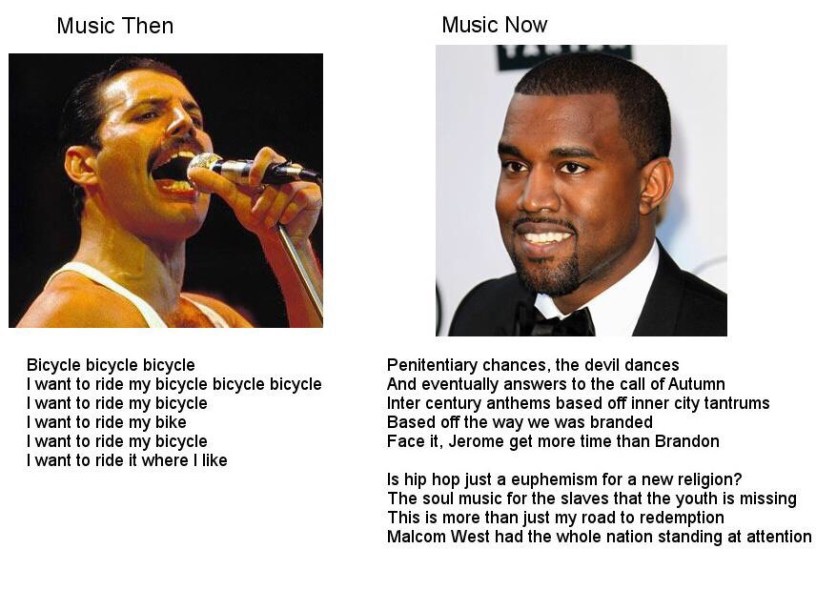
While discussing music with people of various ages (“Hey, do you like Vanilla Ice?”), one of the most common gripes is one that we have all pondered at one point or another, especially after examining pop culture under a microscope. “What Has Happened to Music?” “Pop music is so rubbish; Nicki Minaj and Miley Cyrus have no talent.” Why are Pop acts representative of our generation anyway? “Back in the days we used to have the Beatles and Led Zeppelin, I was born in the wrong generation!” First of all, as if any narcissist can survive in a generation where the smartphone or any type of mobile phone was not even invented yet, and second of all, I think this type of mentality could not be further from the truth. Allow me to explain myself.
For starters, there is no accounting for taste, meaning who is to say that something is good or bad? We would live in a very boring world, or perhaps a near totalitarian state, if we all liked the same things. Diversity, conflict and discussion would be a thing of the past, and besides, people of different ages can never have identical viewpoints. While we may agree that some artists are objectively better than others (check the aforementioned artists) if someone is passionate about any form of music, any counterpoint will be futile. They are doing no harm and music has been around in some shape or form for around 40,000 years, it can survive some less than stellar acts. There is a time and a place for everything, including pop music. Pop music obviously orbits the club/dance scene, and that’s what works in the context of a club full of sweaty Geordie Shore knockoffs. While there is no hope in this week’s chart, “quality” and “artistry” do prevail at times, such as the cases of Frank Ocean and Kendrick Lamar.
Secondly, this is an age old argument. Elvis was once considered rebellious and blasphemous by everyone outside his fan base (teenagers and young adults- notice a pattern?) Frank Sinatra even had this to say about the King of Rock and Roll: “His kind of music is deplorable, a rancid smelling aphrodisiac. It fosters almost totally negative and destructive reactions in young people.” Times have certainly changed. A decade later, older generations bemoaned the Beatles and the psychedelic culture. A subculture was developing known as punk as a reaction to the overindulgence of progressive rock. Many people thought that punk bands could not play their instruments properly. Disco was seen as the death of Rock and Roll and so forth. You get the picture; it’s natural to despise music and certain subcultures that differ from your own ethos. The reason why all these subgenres emerged is simple; evolve or be extinct. While these are timeless styles, we do tend to get tired of hearing the same old and long for a new, edgier sound and embodiment.
Furthermore, there is another reason for this rhetoric, one that is perhaps the most justifiable. This whole notion is shared commonly among rock and rap fans (some people do believe that Hip Hop died with Tupac). We have to be honest with ourselves here, and the main reason we feel this sentiment is simple. Rock music is hardly ever represented on the radio, clubs, ect. Why? It does not represent the zeitgeist of our time. I am not saying it is irrelevant, but is it a sign of our times? Music is culture, which in turn is society, so everything found in music is also prevalent in society. When thinking about any decade between the ‘60s-‘90s, I am almost certain you are conjuring up a timeline that starts with The Beatles and ends with Nirvana. Those are also, incidentally, some of the best-selling acts of all time. Who will represent our decade? I have one guy in mind, but I will not mention him as I do not want to lose any potential readers. There are still great rock bands alive and kicking, but very few of them are innovating. Rock music is currently going through a midlife crisis, focusing on how great those younger days used to be. This is no problem whatsoever, but makes it harder to capture this spirit we crave, especially since we have shorter attention spans than ever before. It is a little known fact that “bad” music was also prevalent in past decades. When browsing Classic Rock stations or “Golden Oldies” playlists, there will obviously be no afterthought for anything that is not considered a classic, meaning that it is all but forgotten.
If anything, this is the best age to be alive for a music listener. We can listen to literally anything we want, anywhere and as many times as we desire. The possibilities are endless, thus explaining the lack of rigid barriers between genres and its fans. You could headbang to a Slayer song before vibing to a Drake banger, even making a mash up if you have the skill and time. How is that not awesome? The Internet also shines light on older acts you otherwise would not have heard of, if you really do not relate to any current acts. While I agree listening to The Dark Side of The Moon may have had more of an impact in 1973, you do not have to scramble for a copy of it or for any other album in that case! Never has the average listener had as much power as we do now, as exposure to music far exceeds radio, MTV and soundtracks. In fact, I would say there is too much good music! According to Billboard, there are approximately 75,000 albums released each year! The average album receives a critic score of 73. They can’t all be horrible, right? I will end this blog post by presenting one of my favourite songs of last year, to illustrate my point. Had it not been for the Internet, Father John Mistey’s fan base would probably be relegated to a local or regional scene. There is no longer any good music you say? You aren’t looking hard enough!
 Hear This, Not That
I couldn’t agree with you more. Nice article 🙂
LikeLike